Nick Williams is the UK’s leading coach and author for Inspired Entrepreneurs. He has inspired tens of thousands of people to discover the work they were born to do and then helps them to live that either through employment or by being entrepreneurial through their own business. Over 10,000 people have attended more than 1,000 live events with Nick in over 100 cities and towns in 15 countries. His work has been the focus of over 1,000 media features. Nick is a living role model and an inspiring speaker. He has also written “The Work We Were Born To Do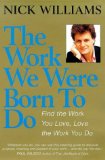
The main points of Nick’s interview were:
-
It’s okay to get paid to do something that you love. Work does not mean that you need to suffer. Take the time to look at what messages you picked up about work as you were growing up.
-
Believe in a new possibility. Don’t be put off by set backs. Take baby steps. Generally massive leaps don’t work and you can fall flat on your face. The baby steps can lead to massive leaps.
-
Nick’s top 3 steps to finding your passion are:
-
What would inspire you? Create space in your mind that work can be something that inspires you. Entertain the idea that inspired ideas could lead to a new place. Capture ideas of what would inspire you in a journal etc. It’s too easy to be dismissive of those ideas. You may discover that you are capable of doing things you didn’t realise you were capable of. People tend to be waiting for inspiration rather than creating inspiration.
-
What is your greatest resistance? What is the thing that you spend most of your energy telling yourself you can’t do i.e. you don’t have the money/time, have children to support, your partner is not supportive or you generally procrastinate about. Resistance doesn’t ever go away, you simply get used to dealing with it – if you want to write a book then simply write the first paragraph. Its important to learn to recognise the difference between something not feeling right and something feeling scary. Understand the greater the resistance, the greater the energy/passion/excitement you have for that project. Resistance can be a sign post.
-
Look in your shadow life. The parts of you that you have disowned e.g. you want to write a book so get a job in a book store so can rub shoulders with authors; you are around the area that you want to be in but you never actually write the book. A similar idea is that of the “shadow artist”. The term was coined by Julia Cameron, author of the “The Artists Way”, and she observed people surrounding themselves with the kind of art they wanted to do but never actually got around to doing any of it themselves. Nick said to observe your behaviour; when you walk into a bookstore what area would you gravitate towards? What are you endlessly curious about? Whose career are you most jealous of?
The 2nd and 3rdsteps really resonated with me as I have definite areas of resistance so I am making an effort to answer myself the hard questions that Nick has asked.
There are actually 9 of these steps. Nick has kindly created a free program around these steps that you can download from Inspired Entrepeneur. I’ve downloaded it along with 22,000 other people!
Nick then went on to discuss strategies for setting up your own business:
-
The 5-9 idea – work on your business in the evening while keeping your 9-5 job. This can resolve money anxiety or it may simply be that you don’t want to give up your job. There is an emotional freedom if you still have your job and the income from it; it will remove any desperation.
-
Have a big idea. Chuck it down. Choose your first deliverable. I think this is really effective to think in turns of your first deliverable as you are aiming to write the first paragraph of your book rather than the whole thing. It makes starting much less daunting.
-
Overcome the feeling that there is already competition in your area and that there is no space for you. None of us is doing anything original, there are simply universal ideas. What each of us is called on to do is to deliver those universal ideas in our own authentic way to a group of people who want to hear about it from us. People are hungry for those who are leading their own lives and will then lead others. Nick recommended a book called “Tribes”, by Seth Godin, as this had a dramatic change on how he viewed competition.
-
Find your first non friend/family client. Once you do this then you have proved there is a demand for what you do.
-
Find the intersection between what you love doing and what people need. Nick discussed coaching and how many coaches can find it difficult to make a living. He suggested that this was because people don’t actually want to be coached, they really want the result of having been coached. I can really related to this as I have been coached and have also trained as a coach. Nick mentioned this quote from Aristotle: “Where your joy and talent, and the needs of the world, meet there lies your vocation” Think about how to package coaching so that people really want it/benefit most from it. What form do people want their coaching in?
-
Give away bits of you so people get a taste of you and want more. Always come back to your intention e.g. how can I serve/make a difference?
The next speaker is Jessica Pryce-Jones, author of “Happiness at Work”and CEO of iOpener.